
Big Water

In Southern California’s quiet Bell Park, there’s a war going on. Old guard commissioners from the town’s water board are making a bid to privatize the cash-strapped small municipality’s water supply. But the resident’s smell a rat and organize. Hometown organizer Melinda Cruz finds herself at odds with her brother, Jaime, who works for Double Six, a multi-million dollar designer water label lusting to capture the town’s historic acquifer.

Written by crime novelist Gary Phillips, illustrated by Manoel Magalhães, with an introduction by Kim Stanley Robinson, preface by Gilda Haas and afterword by Cyndi Hubach.
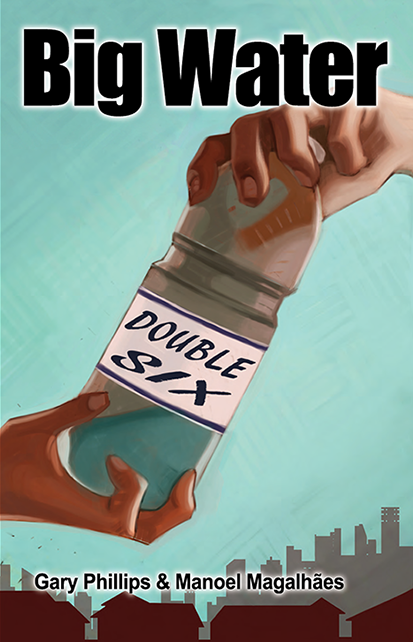
Big Water

Big Water’s Kickstarter How-To

click the image below to read article

Kickstarter Rewards

READ the graphic novel for FREE on GLOBALCOMIX

L.A. Times Review

In Gary Phillips, Manoel Magalhães’ graphic novel, water is power

I like Gary Phillips. I like his fiction — especially the Ivan Monk series of mysteries — and I like his commitment to community, his notion that narrative is (or can be) a form of activism, that we learn or dream the future into being by the stories that we tell.

Phillips is a native Angeleno, and from the first Monk novel, “Violent Spring,” which takes place in the aftermath of the Rodney King riots, his work has shown a remarkable relationship to place. For the last seven years, he has written for the advocacy website FourStory, and his latest project, the graphic novel “Big Water” (Dr. Pop: unpaged, $19.95) illustrated by the Brazilian artist Manoel Magalhães, comes out under the auspices of Dr. Pop, a self-described “popular education” website that focuses on stories about “the economy, urban planning, and democracy work, … offer[ing] tools for organizers, educators, students, activists and all manner of curious people who are interested in change.”

“Big Water” is a book about, yes, big water, and the shifting tides of power in a landscape where the most basic resources are at stake. Set, for the most part, in the fictional town of Bell Park, “nestled in the sprawl of southeastern Los Angeles County,” it tells a story as old as the region itself.

“Whoever brings the water brings the people,” William Mulholland once said, famously; the line appears on the back cover here. That’s as true now (truer, even) as it was then, and it functions as a signifier for the movement of the graphic novel, which involves a high-end water company in Culver City, corrupt local officials and a hotly contested election for the Bell Park water board.

At heart here are questions that resonate beyond fiction: Who controls the water? And what do we do when it becomes a commodity? But the strength of “Big Water” is that Phillips and Magalhães explore this through the conflicts and interactions of human beings. This is especially effective when it comes to a character such as Jaime, born in Bell Park but an up-and-comer at Double Six, the designer water company that wants to use Bell Park’s water for its own ends.

In a contextualizing afterword, Los Angeles writer Cyndi Hubach connects Phillips and Magalhães’s story to some real-life antecedents, especially the town of Maywood (which Bell Park superficially resembles), where “decades of industrial waste-dumping and poor infrastructure maintenance have resulted in a water supply that is at best unpleasant, and at worst, toxic and potentially carcinogenic.”

Still, to read “Big Water” as roman a clef is to miss the point. Rather, what Phillips and Magalhães have in mind is to create a graphic novel in which issues emerge through character, through situation — and the most essential politics are, as they must be, the most personal, affecting us at the level of our daily lives.

Leave a Reply