Dr. Pop


Dr. Pop Blog

More London 2012: from Stuart Murphy

4/2/2010 by Celine Kuklowsky - 2 comments


I recently received a kick-ass comment from a friend of mine named Stuart Murphy. He had some insight to share on the development of the London Olympics and how it’s affecting community here. Thought I’d give him a little shout-out and repost his comment here. Thanks Stu!


From what I can gather through working on an employment project across Tower Hamlets, Hackney and Newham (3 of the 5 host boroughs) over the last few years very few local people seem to be benefiting even from the short term construction boom. To my mind, those construction jobs aren’t being done by local people to the extent thats been promised. And thats not meant in the Nationalistic ‘they’re all Polish immigrants’ sense.


Anecdotally it seems that contractors have bussed people in from wherever, to the extent of even giving them fake local addresses in order to skew the stats and not get too much heat from the Olympic Delivery Authority for not employing locals. Not that there would be too much heat, as the targets for employing locals appear only to be aspirational. Its unclear that Section 106 Agreements (see link for definition: http://www.idea.gov.uk/idk/core/page.do?pageId=71631) are in place or being enforced, so there’s basically no accountability, and therefore no real incentive to hire local.


For instance only in the last week it has emerged that there are only 150 apprentices working on the site, and only 1 from Hackney. Its a 500 acre site, and covered in construction workers.


Here’s a link or two:


London Olympic Park construction equipment, by renaissancechambara (via Flickr).

London Olympic Park construction equipment, by renaissancechambara (via Flickr).

Artists Redevelop Better

3/30/2010 by Gilda Haas - No comments


Last month I had the privilege and rare opportunity to visit Cuba, traveling along with the FourStory crew, friends, and family.  A dozen or so people –  mostly writers, a few academics, artists, an architect, a developer, a high school teacher, a graduate student, and a lady barber.  Good traveling companions.


I confess to tourist status.  What I appreciated most from my short visit was the art, the music, and, of course, the people.  As is often the case, one benefit of the trip was returning with a new lens that lets me  appreciate some things at home with new eyes.


So here is one of my favorite Havana places, with a trackback to home.


Fuster


Fuster  house


This is a photo of our team entering the amazing home of José Fuster, a disneyland of colorful tile and whimsical comfort.  It is also a deeply political location, in terms of the owner-builder’s idea and practice of art-as-redevelopment in the Jaimanitas neighborhood of Havana.

Read More…

Who owns the game?

3/16/2010 by Ryan Lugalia Hollon - No comments


jumpshot


This month Dr. Pop is all about sports and politics, about the ways that the love of the game gets mixed up with the love of money and power. Celine examines the “rules of the games” in the upcoming London Olympics, Gary comments on a recent drive for professional football in LA spearheaded by a local power broker, and Andrea turns her eye to the collateral consequences of the 2010 African Cup of Nations. Each story deals with the tension between sports for the sake of enjoyment, and sports for the sake of enhancing market values or securing political futures. They address the ways that athletic competitions have become a key fixture in the contemporary global political economy.


This unique mixture, between the politics of sports and the economic game of politics, comes into play every time a city faces a decision about building a new stadium or a country attempts to host a mega-event like the FIFA World Cup.  At stake in these decisions is the deployment of scarce public dollars and vital urban lands. As the future of these resource get decided, a broad collection of stakeholders must debate:  What kinds of benefits might an expanded sports infrastructure bring to our city?  Who will get to enjoy these benefits and for how long? And because these are tough questions, these debates can set off fierce competitions between opposing groups, competitions which make many championship games seem like little-league. To read more about how these questions are being answered in South Africa, check out this recent NY Times article: “Cost of Stadium Reveals Tensions in South Africa.”


At the heart of these debates is the issue of who has the right to access and to enjoy the city. This often becomes a clash between the use value and the exchange value of urban space, between the ways that city dwellers make the most of city lands and the ways these same lands are controlled by outside investors, as well as commercial and government interests.  The 2008 Beijing Olympics offer a clear example of what happens when the concern with building a new sports infrastructure becomes more important than the human rights of urban dwellers. In addition to the seven gold medals won by swimmer Michael Phelps, the Beijing Olympics also featured the displacement of roughly 1.5. million people from their homes.

I will not watch (08 Olympics)

Read More…

London 2012: Green or Mean?

3/16/2010 by Celine Kuklowsky - 7 comments

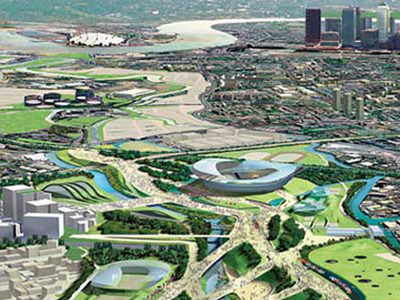
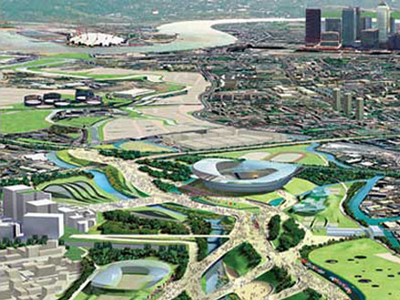
Plan for London Olympics 2012 Village Photo: ecofriend.org

2012 London Olympic Village


In 2012, London will be hosting the Summer Olympics, “the greenest games to date” according to the Olympic Delivery Authority chief executive, David Higgins.


London authorities are gearing up to win the gold in sustainability, with claims of cutting carbon emissions, lighting a carbon neutral Olympic Flame, using recycled materials and cleaning up the brownfield upon which athletes will compete. But that’s not the only legacy the city hopes to accomplish. London is also looking to implement a robust social agenda to accompany the physical regeneration projects. As the Strategic Regeneration Framework report hopefully proposes:


The true legacy of 2012 is that within 20 years the communities who host the 2012 Games will have the same social and economic chances as their neighbours across London.


london olympics

London Olympics Photo: gadiss.com

Read More…